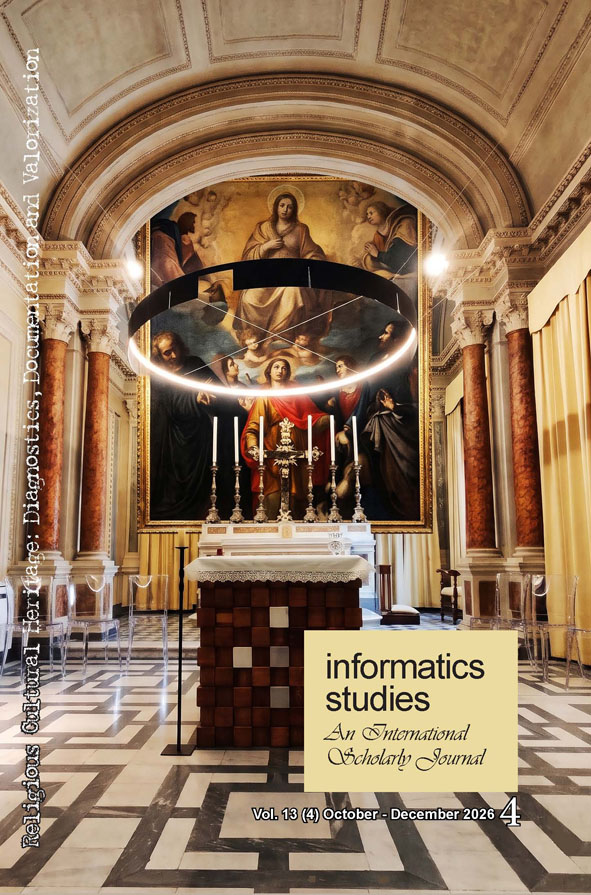
Religious Cultural Heritage: Diagnostics, Documentation and Valorization
DOI:
https://doi.org/10.65408/cird868863Keywords:
Religion, Culture, Heritage, Informatics, Diagnostics, Documentation, Valorization, Conservation, ArchaeologyAbstract
Religious cultural heritage encompasses sacred architecture, archaeological sites, monuments, manuscripts, artworks, music, rituals, and living traditions that embody humanity’s diverse spiritual and cultural experiences. Its preservation requires interdisciplinary approaches integrating scientific diagnostics, digital documentation, conservation practices, and Heritage Informatics. This collection, Religious Cultural Heritage: Diagnostics, Documentation, and Valorization, examines how technologies such as non-invasive imaging, laser scanning, photogrammetry, LiDAR, building information modelling, virtual reality, artificial intelligence, and digital archives support the investigation, recording, conservation, and interpretation of religious heritage. Its contributions explore diverse contexts, including religious music, medieval madrasas, Buddhist traditions, prehistoric landscapes, post-Byzantine monasteries, Gothic epigraphy, and digital knowledge systems. Together, they demonstrate the potential of technological innovation to improve documentation, knowledge access, and public engagement while addressing challenges of authenticity, sustainability, and cultural continuity. The volume advocates responsible valorization grounded in interdisciplinary collaboration, ethical practice, and community participation, ensuring that heritage remains a meaningful resource for future generations.
References
Donatella Fiorani (2009). Restauro e tecnologie in architettura, Roma, Carocci Editore.
Giorgio Torraca (2002). Lezioni di scienza e tecnologia dei materiali per il restauro dei monumenti, Roma, Università La Sapienza.
Gireesh Kumar T. K. and Olimpia Niglio (2025). Cultural Informatics: Challenges and Prospects. Rome: Aracne Editrice.
Mauro Matteini e Arcangelo Moles (1990). Scienza e restauro. Metodi d’indagine, Firenze, Nardini Editore, 1990
Olimpia Niglio (2004). Tecnologie diagnostiche per la conservazione dei beni architettonici, Padova, Il Prato Editore, 2004
Olimpia Niglio (2022). Regenerating Cultural Religious Heritage. Intercultural Dialogue on Places of Religion and Rituals, Singapore, Springer Nature.
Olimpia Niglio (ed.) (2026). Ereditare il patrimonio culturale religioso. Lomello e la Basilica di Santa Maria Maggiore, Roma, Aracne Editrice.
Paul Schafer. (2026). The Cultural Age: Heart, Soul, and Centre of the World. Rock’s Mills, ON, Canada: Rock’s Mills Press.
Downloads
Published
Issue
Section
License
Copyright (c) 2026 Olimpia Niglio, Gireesh Kumar T K

This work is licensed under a Creative Commons Attribution 4.0 International License.
Submission of a manuscript to IS indicates that the work is original, has not been previously published (except as an abstract, lecture, or thesis), and is not under consideration by another journal. By submitting, authors affirm that their manuscript meets the journal’s ethical and editorial standards and that they agree to the terms of copyright and licensing upon acceptance.
Once accepted for publication, authors grant IS the first publication rights to the work. However, authors retain full copyright of their content and remain the legal owners of their intellectual property.
IS provides open access to all published articles six months after the release of the respective volume. Once the embargo period concludes, articles are made freely available under the Creative Commons Attribution (CC BY) License (https://creativecommons.org/licenses/by/4.0/). This license allows users to share, adapt, and reuse the work in any medium or format provided that appropriate credit is given to the original authors and the initial publication in this journal.
The journal's delayed open access model supports global knowledge dissemination, ensuring that research is accessible without financial or legal barriers. Authors are also encouraged to archive their published articles in institutional repositories, personal websites, or other platforms, with full citation of the journal version. Pre-print versions posted online should include a citation and link to the final published version in IS as soon as the issue is available; post-print versions (including the final publisher's PDF) should include a citation and link to the journal's website.
All materials published in the IS website are distributed under a Creative Commons Attribution license, unless otherwise noted.