Valorizing Post-Byzantine Religious Heritage through Digital Documentation and VR: The Monastery of Profitis Ilias at Zeli
DOI:
https://doi.org/10.65408/cird176637Keywords:
Saeta, Religious Cultural Heritage, Heritage Informatics, Digital Mapping, Flamenco, CáceresAbstract
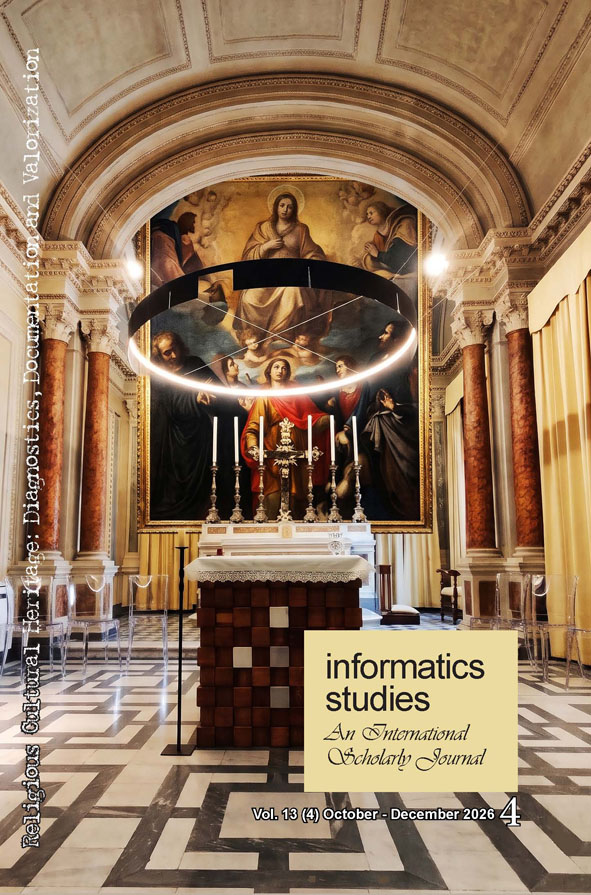
This paper presents a workflow for transforming high-fidelity digital documentation of a post-Byzantine monument in Phthiotis, Greece, into optimized and reusable digital assets for both preservation and public engagement. The case study is the 18th-century katholikon (main church) of the Monastery of Profitis Ilias at Zeli, one of 15 ecclesiastical monuments selected by the Metropolis of Phthiotis for photogrammetric documentation within a dedicated digitization project. The proposed approach establishes a digital archive that serves both as a comprehensive record for long-term documentation and preservation and as a flexible foundation for real-time virtual experiences. Particular emphasis is placed on maintaining the historical, art-historical, liturgical, and cultural contexts of the monument throughout the digitization and asset-production process. By enabling scientifically documented digital assets to be reused across different forms of interpretation, visualization, and access, the workflow supports the valorization of post-Byzantine heritage while preserving the monument’s historical and cultural significance.
References
Aicardi, I., Chiabrando, F., Lingua, A., and Noardo, F. (2018). Recent trends in cultural heritage 3D survey: The photogrammetric computer vision approach. Journal of Cultural Heritage 32, 257-266.
Allal-Chérif, O. (2022). Intelligent cathedrals: Using augmented reality, virtual reality, and artificial intelligence to provide an intense cultural, historical, and religious visitor experience. Technological Forecasting and Social Change 178. https://doi. org/10.1016/j.techfore.2022.121604
Anastasiadou, M. (2023). What we inherited from the Turks. In Kolovos E., Pallis G., and Poulos P. (Eds.). Ottoman monuments in Greece. Heritage under negotiation (pp. 29- 39). Athens: Ecole Française d’Athènes & Kapon Editions.
Bintliff, J. (2019). The transformation of Medieval and Post-Medieval archaeology in Greece. In Gelichi S., Olmo-Enciso L., Corro’, E. and Castro-Priego, M. (Eds.) Mediterranean Landscapes in Post Antiquity New frontiers and new perspectives (pp. 1-6). Oxford: Archaeopress Publishing.
Chlepa, E.-A. (2011). The Byzantine Monuments in Modern Greece. Ideology and Practice in Reconstruction, 1833-1939. Athens: Kapon Editions (in Greek).
Christopoulos, D., Efraimoglou, D., Chatzi, E., and Sofianopoulos, G. (2018). Using virtual reality and storytelling to disseminate heritage sites: ‘Agia Sophia: 1500 years of history’ case study. In: Proceedings of the 2nd Euromed - International Conference on Digital Heritage (Volos, 1-3 December 2017) (pp. 316-323). Volos: Perraivia network (in Greek) https://digitalheritagelab. eu/wp-content/uploads/2023/09/ euromed2017-conference-proceedings_ Final_2v02.pdf
Christopoulos, D., Hatzi, E., Chatzitofis, A., Vretos, N., and Daras, P. (2014). Future Media Internet Technologies for Digital Domes. In: Shumaker, R., Lackey, S. (Eds.) Virtual, Augmented and Mixed Reality. 62 Informatics Studies 13 (4), October - December, 2026 Designing and Developing Virtual and Augmented Environments. VAMR 2014. Lecture Notes in Computer Science, vol 8525 (pp.339-350). Springer, Cham. https:// doi.org/10.1007/978-3-319-07458-0_32
Gonsher, I., and Munshi, S., (2025). Shared Architecture of the Sacred: Designing Sacred Spaces in Virtual Reality. Scholarly Research 6 https://digitalcommons.risd. edu/hpss_scholarlyresearch/6
Ioannidis, C., Soile, S., Boutsi, A.-M., Verykokou, S., Bourexis, F., and Potsiou, C. (2021). From 3D documentation to XR representation of Cultural Heritage buildings -The case of the Katholikon of St. Stephen, Meteora. Conference paper presented in: FIG e-Working Week 2021, Smart Surveyors for Land and Water Management - Challenges in a New Reality: Virtually in the Netherlands (June 20-25 2021) https://www.researchgate.net/publication/353430005_From_3D_ documentation_to_XR_representation_of_ Cultural_Heritage_buildings_-The_case_of_ the_Katholikon_of_St_Stephen_Meteora
Kenely, M., Bugeja, M., Grima, A., Pullicino, P., Pullicino, M., and Seychell, D. (2026). L a r g e - S c a l e P h o t o g r a m m e t r i c Documentation of St. John’s Co-Cathedral: A Workflow for Cultural Heritage Preservation. In Proceedings of the ACM on Computer Graphics and Interactive Techniques (PACMCGIT), in press. https:// arxiv.org/pdf/2604.24316v2
Letellier, R., Schmid, W., and LeBlanc, F. (2007). Recording, Documentation, and Information Management for the Conservation of Heritage Places: Guiding Principles. Los Angeles: Getty Conservation Institute.
Mannoni, C. (2023). Byzantine artefacts versus Classical antiquities. Questioning the early heritage protection in Greece. In Cecalupo C. (Ed.), Revealing Christian Heritage. (pp.29-43). Leiden: Sidestone press.
Néroulidis, A., Pouyet, T., Tournon, S., Rousset, M., Callieri, M., Manuel, A., Abergel, V., et al. (2024). A digital platform for the centralization and long-term preservation of multidisciplinary scientific data belonging to the Notre Dame de Paris scientific action. Journal of Cultural Heritage 65, 210-220.
Downloads
Published
Issue
Section
License
Copyright (c) 2026 Despoina Lampada, Efstathia Chatzi, Dimitrios Christopoulos, Protopresbyter Fr. Neofytos Rafailidis

This work is licensed under a Creative Commons Attribution 4.0 International License.
Submission of a manuscript to IS indicates that the work is original, has not been previously published (except as an abstract, lecture, or thesis), and is not under consideration by another journal. By submitting, authors affirm that their manuscript meets the journal’s ethical and editorial standards and that they agree to the terms of copyright and licensing upon acceptance.
Once accepted for publication, authors grant IS the first publication rights to the work. However, authors retain full copyright of their content and remain the legal owners of their intellectual property.
IS provides open access to all published articles six months after the release of the respective volume. Once the embargo period concludes, articles are made freely available under the Creative Commons Attribution (CC BY) License (https://creativecommons.org/licenses/by/4.0/). This license allows users to share, adapt, and reuse the work in any medium or format provided that appropriate credit is given to the original authors and the initial publication in this journal.
The journal's delayed open access model supports global knowledge dissemination, ensuring that research is accessible without financial or legal barriers. Authors are also encouraged to archive their published articles in institutional repositories, personal websites, or other platforms, with full citation of the journal version. Pre-print versions posted online should include a citation and link to the final published version in IS as soon as the issue is available; post-print versions (including the final publisher's PDF) should include a citation and link to the journal's website.
All materials published in the IS website are distributed under a Creative Commons Attribution license, unless otherwise noted.