Reading the Stones: Digital Epigraphy and the MultiSensory Gothic Archive—Stone, Light and Sound
DOI:
https://doi.org/10.65408/cird159039Keywords:
Digital Epigraphy, Gothic Cathedrals, LiDAR, Reflectance Transformation Imaging, Historic Building Information Modelling, Stained Glass, Digital Archaeoacoustics, Multisensory Heritage, Heritage Informatics, Religious Cultural HeritageAbstract
Gothic cathedrals are remarkable repositories of medieval architecture, craftsmanship, religious expression, and material memory. Beyond their visible forms, they preserve evidence in stonemasons’ marks, inscriptions, stained-glass compositions, natural illumination, material characteristics, and acoustic properties. This paper proposes Heritage Informatics as an integrative framework for documenting, analysing, and interpreting these interconnected layers of cultural heritage. It examines the complementary use of terrestrial laser scanning and LiDAR, digital epigraphy, Reflectance Transformation Imaging (RTI), computer vision, Historic Building Information Modelling (HBIM), spatial databases, material characterization, and digital archaeoacoustics. Particular attention is given to linking visual, spatial, material, historical, and acoustic information through structured metadata, provenance, and interoperable digital systems. Chartres Cathedral and Sainte-Chapelle provide illustrative contexts. The paper addresses uncertainty by distinguishing direct observation from scholarly interpretation and digital reconstruction. It argues that integrating these technologies can strengthen research, conservation, education, public engagement, and the long-term preservation and accessibility of Gothic heritage knowledge.
References
Berardi, U., Cirillo, E., & Martellotta, F (2009). A comparative analysis of acoustic energy models for churches. Journal of the Acoustical Society of America, 126(4), 1838–1849.
Franzini, M., et al. (2021). Terrestrial Laser Scanning and Digital Epigraphy: Analyzing Mason Marks and Surface Geometries in Medieval Architecture. Journal of Cultural Heritage Informatics, 14(2), 112–128.
Meyer, J (2009). Acoustics and the Performance of Music: Manual for Acoustic Specialists, Audio Engineers, and Musicians (5th ed.). Springer.
Mullins, T., et al. (2022). The Past Has Ears at Notre-Dame Cathedral: An Interdisciplinary Project in Digital Archaeoacoustics. Acoustics Today, 20(2), 34–42.
Quagliarini, E., Revel, G. M., & Lenci, S (2014). Historical plasters on light thin vaults: State of conservation assessment by a hybrid ultrasonic method. Journal of Cultural Heritage, 15(1), 104–111.
Tjellesen, L., & Colligan, K (2013). Archaeologists: An Introduction—A New Take on an Old Science. Audio Engineering Society Convention Paper 8861, Rome.
Vance, A (2024). The Digital Palimpsest: Non-Destructive Metrology in Gothic Masonry. Oxford University Press.
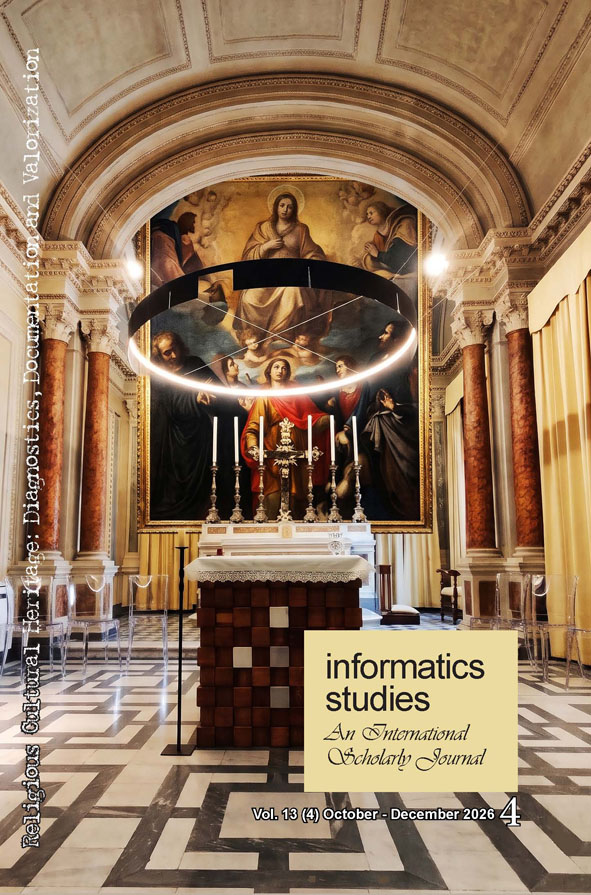
Downloads
Published
Issue
Section
License
Copyright (c) 2026 Annik Meulemans Meulemans

This work is licensed under a Creative Commons Attribution 4.0 International License.
Submission of a manuscript to IS indicates that the work is original, has not been previously published (except as an abstract, lecture, or thesis), and is not under consideration by another journal. By submitting, authors affirm that their manuscript meets the journal’s ethical and editorial standards and that they agree to the terms of copyright and licensing upon acceptance.
Once accepted for publication, authors grant IS the first publication rights to the work. However, authors retain full copyright of their content and remain the legal owners of their intellectual property.
IS provides open access to all published articles six months after the release of the respective volume. Once the embargo period concludes, articles are made freely available under the Creative Commons Attribution (CC BY) License (https://creativecommons.org/licenses/by/4.0/). This license allows users to share, adapt, and reuse the work in any medium or format provided that appropriate credit is given to the original authors and the initial publication in this journal.
The journal's delayed open access model supports global knowledge dissemination, ensuring that research is accessible without financial or legal barriers. Authors are also encouraged to archive their published articles in institutional repositories, personal websites, or other platforms, with full citation of the journal version. Pre-print versions posted online should include a citation and link to the final published version in IS as soon as the issue is available; post-print versions (including the final publisher's PDF) should include a citation and link to the journal's website.
All materials published in the IS website are distributed under a Creative Commons Attribution license, unless otherwise noted.