The End of the Paywall
Keywords:
Open Access, Open Science, Science and Technology, Research, Higher Education, Netherlands, European Union, Sandel Dekker, Dutch. Horizon Europe, Journals.Abstract
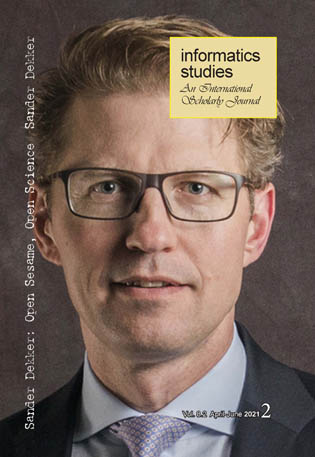
This document is the transcript of the full text of the inspiring speech by the then Dutch State Secretary for Education, Culture and Science; Sander Dekker at the Academic Publishing Conference in Berlin in 2014. For Dekker Open Access is a moral obligation, based on the principles of openness and democracy. It is a matter of principle that the whole of society should have access to the scientific knowledge for which it have paid for, which is essential and inescapable for its progress. Comparing Open Access to the Olympic idea he remarked that ‘participation is not more important than victory, participation is victory’ and pleaded for the end of the pay wall in access to results of research.References
Sander Dekker (2014). The End of the Pay wall. (Transcript of the Speech). Academic Publishing Conference, Berlin, 28 January, 2014 . https://www.scienceguide.nl/2014/01/the-end-of-the-paywall/
Downloads
Published
Issue
Section
License
Submission of a manuscript to IS indicates that the work is original, has not been previously published (except as an abstract, lecture, or thesis), and is not under consideration by another journal. By submitting, authors affirm that their manuscript meets the journal’s ethical and editorial standards and that they agree to the terms of copyright and licensing upon acceptance.
Once accepted for publication, authors grant IS the first publication rights to the work. However, authors retain full copyright of their content and remain the legal owners of their intellectual property.
IS provides open access to all published articles six months after the release of the respective volume. Once the embargo period concludes, articles are made freely available under the Creative Commons Attribution (CC BY) License (https://creativecommons.org/licenses/by/4.0/). This license allows users to share, adapt, and reuse the work in any medium or format provided that appropriate credit is given to the original authors and the initial publication in this journal.
The journal's delayed open access model supports global knowledge dissemination, ensuring that research is accessible without financial or legal barriers. Authors are also encouraged to archive their published articles in institutional repositories, personal websites, or other platforms, with full citation of the journal version. Pre-print versions posted online should include a citation and link to the final published version in IS as soon as the issue is available; post-print versions (including the final publisher's PDF) should include a citation and link to the journal's website.
All materials published in the IS website are distributed under a Creative Commons Attribution license, unless otherwise noted.