Open Access to Research Findings
Keywords:
Education Research, Open Access, Netherlands, European Union, Research Funding, Sanders DekkerAbstract
Open Access (OA) is providing access to knowledge resources - research papers, articles and books free of charge. OA applies to all research domains, including Science, Social Science, Humanities, Medicine, Engineering, and Mathematics and the like. Every year, approximately two million articles appear in 25,000 journals that are published worldwide. Having unrestricted access to research results reported in these publications can only help disseminate knowledge, move science forward, promote innovation and solve the problems that society faces. Internet has made providing instant access to them a reality. Only commercial interests hinder it. As the government funds the research for the public good with the public taxes, the citizens have the right to access the research outputs (data, information and knowledge). In academic environment and among researchers this has become a demand topic of discussion long since. But it required Government action and legislation. The document from Netherlands archive published here is the earliest initiative from any government that influenced the world in making knowledge free and accessible to all.
References
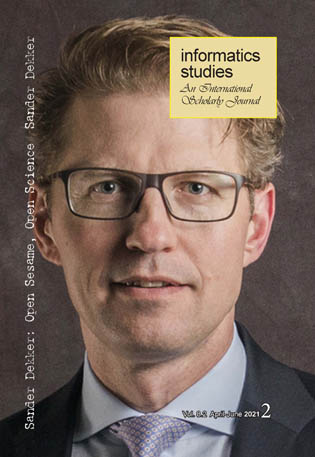
Parliamentary Paper: 31 288. Higher Education, Research and Science Policy. No. 354. Letter From The State Secretary For Education, Culture And Science. To the President of the House of Representatives of the States General. The Hague, November 15, 2013
Downloads
Published
Issue
Section
License
Submission of a manuscript to IS indicates that the work is original, has not been previously published (except as an abstract, lecture, or thesis), and is not under consideration by another journal. By submitting, authors affirm that their manuscript meets the journal’s ethical and editorial standards and that they agree to the terms of copyright and licensing upon acceptance.
Once accepted for publication, authors grant IS the first publication rights to the work. However, authors retain full copyright of their content and remain the legal owners of their intellectual property.
IS provides open access to all published articles six months after the release of the respective volume. Once the embargo period concludes, articles are made freely available under the Creative Commons Attribution (CC BY) License (https://creativecommons.org/licenses/by/4.0/). This license allows users to share, adapt, and reuse the work in any medium or format provided that appropriate credit is given to the original authors and the initial publication in this journal.
The journal's delayed open access model supports global knowledge dissemination, ensuring that research is accessible without financial or legal barriers. Authors are also encouraged to archive their published articles in institutional repositories, personal websites, or other platforms, with full citation of the journal version. Pre-print versions posted online should include a citation and link to the final published version in IS as soon as the issue is available; post-print versions (including the final publisher's PDF) should include a citation and link to the journal's website.
All materials published in the IS website are distributed under a Creative Commons Attribution license, unless otherwise noted.