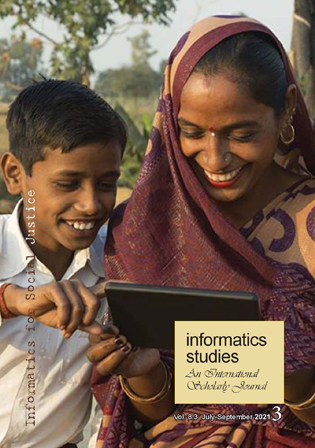
Informatics for Equality of Educational Opportunity: A Survey of Government of India Initiatives
Keywords:
Knowledge Management, Educational Equality, E-learning, Digital Initiatives, Virtual Library.Abstract
India has its own vibrant scientific and knowledge tradition from ancient times. But centuries of foreign domination destroyed its knowledge systems. Modern India also holds rich knowledge heritage and world-class education and research facilities such as Indian Institute of Technology (IITs), Indian Institute of Science (IISc), and reputed universities. But resources available are accessible only to a wealthy minority and not to the majority who cannot afford. Though equal opportunity to knowledge and education is one of the cardinal rights guaranteed by the Constitution of India, its provision is a Herculean task. Informatics can help in making resources accessible, and learning an open and free activity irrespective of the geographical vastness, or economic status of the people. E learning enables sharing of study tools in all kinds of formats such as live interactions, videos, slideshows, word documents and PDFs, conducting live online classes and communicating via chats and messages. The paper surveys the Government of India’s initiatives for transforming knowledge and education system compliant to networked society, for providing equal opportunity to all for their access.
References
B Naresh , Bhanu Sree Reddy “A review: initiation of Indian government in implementing elearning system”. International Journal of Pure and Applied Mathematics. (2018) 118. 18,4293-4300.
MS Vijay Kumar. “Open Educational Resources in India’s national development.” Open Learning: The Journal of Open, Distance and e-Learning., 2009
Sangita Rawal, Dr US Pandey. E-Learning: Learning for Smart Generation Z. International Journal of Scientific and Research Publications. 2013, 3(5).
Neelam Rani “Digitalization of higher education in India - A technological revolution”. International Journal of Applied Research 2019. 282-285.
Indian Institute of Technolody, Kharagpur (2020). https://ndl.iitkgp.ac.in
INFLIBNET (2020).https://epgp.inflibnet.ac.in
India, Govt of. Education, Min of (2020). https://swayam.gov.in
Indian Institute of Technology, Bombay (2020). http://oscar.iitb.ac.in
INFLIBNET (2020).. https://shodhgangotri.inflibnet.ac.in
University of Delhi (2020). http://vle.du.ac.in
INFLIBNET (2020). https://www.inflibnet.ac.in/ess
Downloads
Published
Issue
Section
License
Submission of a manuscript to IS indicates that the work is original, has not been previously published (except as an abstract, lecture, or thesis), and is not under consideration by another journal. By submitting, authors affirm that their manuscript meets the journal’s ethical and editorial standards and that they agree to the terms of copyright and licensing upon acceptance.
Once accepted for publication, authors grant IS the first publication rights to the work. However, authors retain full copyright of their content and remain the legal owners of their intellectual property.
IS provides open access to all published articles six months after the release of the respective volume. Once the embargo period concludes, articles are made freely available under the Creative Commons Attribution (CC BY) License (https://creativecommons.org/licenses/by/4.0/). This license allows users to share, adapt, and reuse the work in any medium or format provided that appropriate credit is given to the original authors and the initial publication in this journal.
The journal's delayed open access model supports global knowledge dissemination, ensuring that research is accessible without financial or legal barriers. Authors are also encouraged to archive their published articles in institutional repositories, personal websites, or other platforms, with full citation of the journal version. Pre-print versions posted online should include a citation and link to the final published version in IS as soon as the issue is available; post-print versions (including the final publisher's PDF) should include a citation and link to the journal's website.
All materials published in the IS website are distributed under a Creative Commons Attribution license, unless otherwise noted.