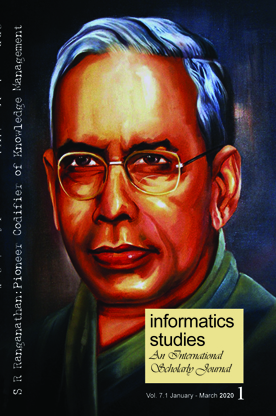
Public Library System for States in a Federal Country Envisaged by Dr. S R Ranganathan
Keywords:
S R Ranganathan, Library Legislation, India, Public LibraryAbstract
Discusses S R Ranganathan’s Model Act for Public Library legislation in States of a federal country, which is to form the second level component of Union Legislation. Draft Bill prepared for Kerala is also covered as a sample. Opines that his was an unique vision of Public Library Network, connecting Public Libraries, Academic Libraries and Special Libraries including Parliament and Legislature libraries to canalize the total information resources of the nation to one and all through an integrated system. The major portion of our information resources held by large institutions like National Library, Connemara Public, National Science Library etc still function as independent institutions serving only the limited population even half a century after Ranaganathan presented this Model Legislation. The Model Act for States he has prepared is very scientific and is still relevant and can be adopted incorporating the slight changes necessitated by technological developments.
References
Development Plan: Thirty-Year Programme for India with Draft Bills for The Union and the Constituent States. Delhi: Delhi University
Libraries Act 1948. Madras, Govt Press. Madras, govt of. (1948). Madras Public Ranganathan, S.R. (1950). Library
Published
Issue
Section
License
Submission of a manuscript to IS indicates that the work is original, has not been previously published (except as an abstract, lecture, or thesis), and is not under consideration by another journal. By submitting, authors affirm that their manuscript meets the journal’s ethical and editorial standards and that they agree to the terms of copyright and licensing upon acceptance.
Once accepted for publication, authors grant IS the first publication rights to the work. However, authors retain full copyright of their content and remain the legal owners of their intellectual property.
IS provides open access to all published articles six months after the release of the respective volume. Once the embargo period concludes, articles are made freely available under the Creative Commons Attribution (CC BY) License (https://creativecommons.org/licenses/by/4.0/). This license allows users to share, adapt, and reuse the work in any medium or format provided that appropriate credit is given to the original authors and the initial publication in this journal.
The journal's delayed open access model supports global knowledge dissemination, ensuring that research is accessible without financial or legal barriers. Authors are also encouraged to archive their published articles in institutional repositories, personal websites, or other platforms, with full citation of the journal version. Pre-print versions posted online should include a citation and link to the final published version in IS as soon as the issue is available; post-print versions (including the final publisher's PDF) should include a citation and link to the journal's website.
All materials published in the IS website are distributed under a Creative Commons Attribution license, unless otherwise noted.